Homeowners Associations, or HOAs, are common throughout the Triangle area—especially in Raleigh, Durham, Chapel Hill, Cary, and Wake Forest. Whether you're buying a home in a new development or an established neighborhood, there's a good chance an HOA will be part of the equation.
Homeowners Associations, or HOAs, are common throughout the Triangle area—especially in Raleigh, Durham, Chapel Hill, Cary, and Wake Forest. Whether you're buying a home in a new development or an established neighborhood, there's a good chance an HOA will be part of the equation.
In this post, we’ll break down:
What HOAs are
How much they cost
What they typically cover (and don’t)
🔍 What Is an HOA?
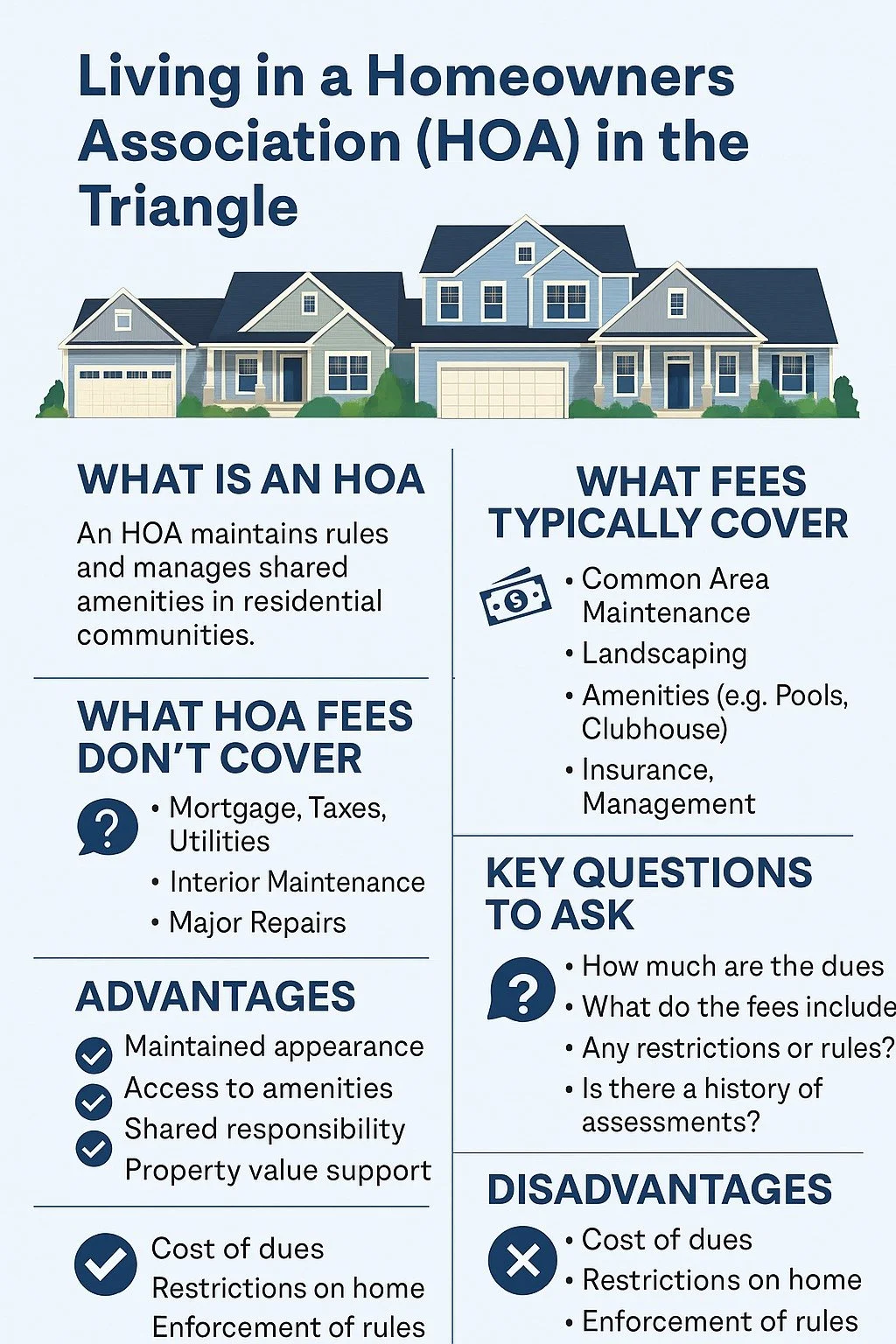
An HOA is an organization created by a neighborhood’s developer to enforce community rules and maintain shared amenities. Once the neighborhood is built out, the HOA is usually turned over to a board of homeowners who manage it on behalf of the community.
In the Triangle, HOAs are especially common in:
New construction neighborhoods
Townhome communities
Master-planned developments
💸 What Do HOA Fees Typically Cover?
OA dues vary depending on the type of neighborhood, amenities, and level of management. Most commonly, HOA fees cover:
Maintenance of common areas (entrances, green spaces, sidewalks)
Landscaping and lawn care (especially in townhome communities)
Access to amenities like pools, clubhouses, playgrounds, and walking trails
Trash and recycling services (in some communities)
Insurance on shared structures (such as townhome exteriors or roofs)
Management fees for bookkeeping, legal, and administrative costs
Reserve fund contributions for large future repairs or replacements
🚫 What HOA Fees Don’t Cover
It’s important to note that HOA fees typically do not cover:
Your mortgage or homeowners insurance
Individual home maintenance or repairs
Utilities inside your home (except in some condos)
Property taxes
Major improvements or damages beyond budget—this may lead to special assessments
📊 How Much Are HOA Fees in the Triangle?
HOA fees in the Raleigh–Durham–Chapel Hill area typically range between $50 and $300 per month, depending on the type of community and its amenities.
Luxury neighborhoods and golf course communities may charge $1,000 or more annually.
Townhome communities with shared exterior maintenance and landscaping will often have higher monthly dues than single-family home communities.
✅ Pros of Living in an HOA Community
Well-maintained appearance: Uniform landscaping, clean streets, and tidy entrances help protect home values.
Amenities: Pools, playgrounds, tennis courts, fitness centers, and walking trails add lifestyle perks.
Shared responsibility: You don’t have to worry about managing common space upkeep or hiring your own contractors.
Property value support: Homes often maintain or increase value thanks to appearance standards.
Community governance: Residents can vote on rules, improvements, and budgets through elected HOA boards.
❌ Cons of HOA Communities
Added cost: HOA dues are in addition to your mortgage, taxes, and insurance.
Restrictions: Rules may limit paint colors, fence types, exterior décor, parking, and even holiday decorations.
Enforcement issues: Fines can be imposed for non-compliance, and unpaid dues may lead to liens or foreclosure.
Risk of poor management: Mismanaged funds, under-funded reserves, or board disputes can negatively affect the community.
❓ Questions to Ask Before Buying in an HOA
How much are the dues and how often do they increase?
What exactly do the fees cover?
Is there a history of special assessments?
What restrictions or rules exist?
Is the HOA professionally managed or run by volunteers?
Are meetings and finances transparent?
🏡 Example HOA Communities in the Triangle
| Community | Location | HOA Fees (Est.) | Includes | Type |
|---|---|---|---|---|
| Heritage Wake Forest | Wake Forest | $135/mo | Pool, tennis, trails, clubhouse, landscaping | Master-planned |
| 12 Oaks | Holly Springs | $600–$1,200/yr | Golf, tennis, pools, landscaping, security | Luxury golf |
| Brier Creek | Raleigh | $150–$300/mo | Landscaping, pool, fitness, security | Luxury townhome/single |
| Southern Village | Chapel Hill | $60–$100/mo | Trails, landscaping, community park | Traditional neighborhood |
| Brightleaf at the Park | Durham | $50–$85/mo | Pool, clubhouse, common area upkeep | New suburban |
| Bedford at Falls River | Raleigh | $75–$125/mo | Trails, pool, clubhouse, landscaping | Established community |
| Chancellors Ridge | Durham | $40–$60/mo | Pool, clubhouse, common areas | Affordable suburban |
| West Cary | Cary | $50–$150/mo | Varies by subdivision | Mixed development |
| Downtown Raleigh | Raleigh | $0–$100/mo | Minimal or none | Urban/loft |
| Fearrington Village | Pittsboro | $120–$180/mo | Clubhouse, events, trails, private roads | Planned village |
📝 Final Thoughts
Homeowners associations can be a great fit for buyers looking for convenience, shared amenities, and neighborhood consistency—but they’re not for everyone.
Before buying in an HOA community, be sure to:
Review the rules and budget
Talk to current residents
Understand exactly what you're agreeing to
Need help finding the right neighborhood—HOA or no HOA—in the Triangle?
Reach out to Jim and Lori Hill for expert guidance on homes in Wake Forest, Raleigh, Durham, Chapel Hill, and beyond.